Mineral Oil versus Natural Ester: Transformer Life-Cycle Cost Boundaries in 2026
Compare an illustrative 2000-litre fill premium against documented installation credits and maintenance; avoid converting crude prices into fluid quotations.
AI-generated editorial illustration; it does not depict a verified project, actual prices or chart data.
1. The procurement decision
The useful decision is whether a qualified ester design reduces total project cost enough to justify its fluid and commissioning premium. Separate new-build selection from retrofilling an existing asset: the latter has compatibility, outage and residual-fluid conditions that do not exist in a clean new fill. The owner needs two compliant alternatives for the same duty, not a mineral-oil tank with an unapproved fluid substitution. Fire, environmental and insulation properties can affect layout or maintenance, but a laboratory property does not itself create a cash saving. The following model therefore values a documented installation credit and a declared monitoring difference while leaving reliability benefits unpriced.
2. August–early October evidence and price basis
The World Bank October release concerns earlier monthly commodity observations, not October finished-fluid quotes. August and September procurement comparisons need the same mineral-oil grade or ester product, packaging, batch size and delivery basis. No public verified product quotation is available in this analysis. Use the dated OEM technical sheet as a property source and actual project offers as commercial evidence. Do not infer a fluid price increase directly from Brent or vegetable-oil movements: their conversion and contract exposure must first be disclosed. On 7 October, no full October average exists.
3. Worked cost model
Mineral transformer oil, natural ester and synthetic ester are separate products. A crude-oil benchmark cannot establish an insulating-fluid price: refining, formulation, purification, packaging, batch size and qualification intervene. No verified public August or September 2026 mineral transformer-oil or ester supplier quotation is asserted here. Cargill's FR3 technical page documents properties for its own natural ester and distinguishes typical values from acceptance specifications. Manufacturer property data support a technical comparison; they do not prove that a site's fire protection can be removed or that an asset will last a predetermined number of extra years. Keep those benefits outside the base economics until the designer, authority and insurer provide project evidence.
Assume a new-build project using 2000 litres of either qualified fluid. Illustrative fluid-only prices are 2 USD/L for mineral oil and 4 USD/L for natural ester, giving 4000 and 8000 USD, hence a 4000 USD premium. These are hypothetical numbers, not observed quotations. Assume 1000 USD additional initial commissioning work for the ester case and 50 USD/year additional monitoring for 10 years. At a hypothetical 8% discount rate, factor 6.7100814 makes that monitoring 335.50 USD present value. Before any installation credit, incremental cost is 4000 + 1000 + 335.50 = 5335.50 USD.
A documented 5000 USD installation saving would leave 335.50 USD incremental cost. This boundary holds other transformer capex and electrical losses equal, excludes replacement and residual value, and assumes no avoided failure. A retrofill requires separate draining, compatibility, residual-oil, outage and approval costs; the new-build arithmetic cannot be reused without that scope.
4. Sensitivity and decision trigger
Test documented installation credits of 0, 5000 and 10000 USD while holding all fluid and monitoring assumptions fixed. Net incremental costs are 5335.50, 335.50 and −4664.50 USD/project; a negative result means a saving relative to the mineral-oil baseline within this boundary. The break-even installation credit is 5335.50 USD. A general claim that ester is safer cannot substitute for a priced, approved design change in that credit.
Request two compliant layout quotations and separate any assumed bund, wall, separation distance or suppression difference. Keep fluid losses, viscosity-related cooling and loading limits under manufacturer approval. Do not capitalize hypothetical longer insulation life as certain cash flow. If the owner wants to model reliability, add a separately identified expected-cost analysis supported by actual failure evidence and avoid counting the same avoided event in insurance and outage benefits.
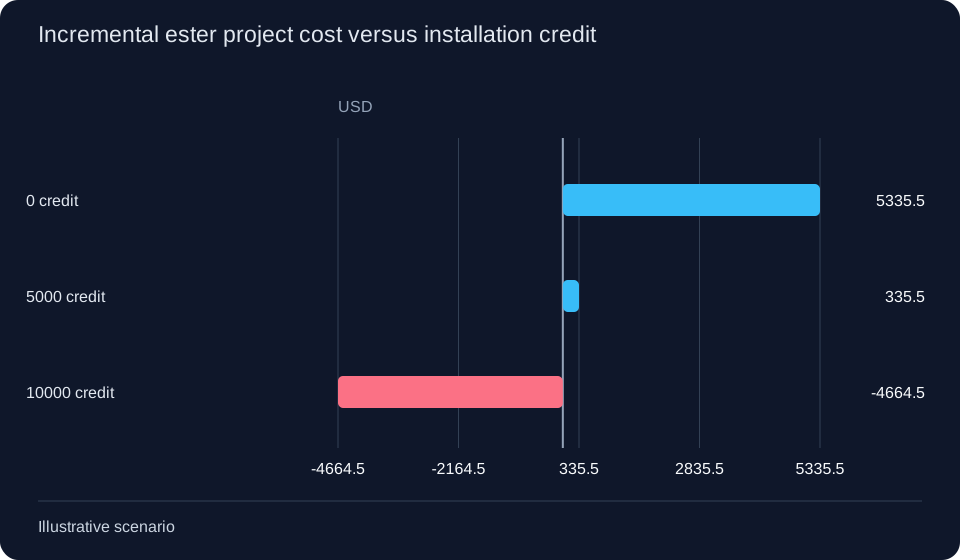
Illustrative 2000 L project: 4000 USD fluid premium, 1000 USD commissioning and 335.50 USD monitoring present value (10 years, 8%). Credits are USD/project; negative values denote bounded savings, not vendor quotes or assumed avoided failures.
| Scenario | Input basis | Cost result |
|---|---|---|
| 0 credit | 0 credit | 5335.5 USD |
| 5000 credit | 5000 credit | 335.5 USD |
| 10000 credit | 10000 credit | -4664.5 USD |
5. Contract evidence and implementation
Request fluid acceptance specifications, batch certificates, storage and filling instructions, warranty terms and the manufacturer's approved thermal design. For retrofill, obtain written approval for seals, accessories, paper condition, draining and the final mixed-fluid properties. Ask the designer and insurer to confirm any credited layout or protection change in writing; otherwise set the installation credit to zero. Record initial and recurrent monitoring separately, with actual sampling intervals and laboratory scope. A manufacturer claim about extended paper life must not become a guaranteed asset-life extension in the financial sheet. Keep property evidence, operating approval and price evidence as separate records.
6. Operating cost and accounting boundary
This comparison uses nominal USD/project and a 10-year discounted incremental cost, not a complete transformer replacement model. The fill volume is 2000 L; it must not be replaced by 2000 kg without density and temperature conversion. Initial premium and commissioning occur at purchase; monitoring is assumed at each year end. Tax, freight, disposal, outage, financing and residual value are excluded. If either design has different electrical losses, cooling auxiliaries or maintenance requirements, add them explicitly instead of treating all ester fluids as one generic option. The break-even result changes when those cost boundaries change.
7. Frequently asked questions
Does biodegradability eliminate containment costs? Not automatically; obtain project approval for the actual installation.
Can paper-aging tests prove a fixed asset-life extension? They inform the technical case, but an entire transformer has other failure mechanisms. No extension is monetized here.
Can the new-build model price a retrofill? Only after adding compatibility, draining, residual-fluid, outage and approval scope; otherwise it omits material costs.
Continue with the transformer procurement cost bridge, transformer loss valuation and ROI calculator.
8. References
- Industrial Electricity Bills: Energy, Network and Demand Costs in 2026
- EU–US Industrial Power Prices: Match Tax, Currency and Delivery Basis
- Natural Gas and LNG: From Hub Benchmark to Delivered Industrial Cost
- Brent, WTI and Refinery Energy Costs: A Margin Scenario Bridge
- Transformer Procurement: A Copper, Aluminium, Oil and Currency Cost Bridge
- Copper and Aluminium Winding Costs: Metal Pass-Through and Indexation in 2026
- GOES Electrical Steel Economics: Yield, Loss and Grade Premium in 2026
- Mineral Oil versus Natural Ester: Transformer Life-Cycle Cost Boundaries in 2026
- Lithium, Nickel and Graphite Exposure: Battery Procurement Cost Bridges in 2026
- Recycled Copper Economics: Quality, Recovery Yield and Energy Cost in 2026
- Transformer landed cost: Incoterms, ocean freight, road delivery and insurance in 2026
- Transformer heavy haul: route, permits, storage and remobilization costs
- LNG shipping economics: freight, boil-off and delivered energy cost
- Port delay economics: working capital, storage and equipment demurrage
- Diesel and bunker freight surcharges: an auditable indexation model
- Solar LCOE: Financing, Curtailment and Interconnection in 2026
- Wind Capture Price: Congestion, Export Losses and Revenue
- BESS Arbitrage: Throughput, Degradation and Net Spread
- Industrial Power PPAs: Fixed, Floating and Profile Risk
- Transformer Losses: Capital Premium, Electricity Cost and NPV
- Refinery hydrogen: separate gas, electricity and carbon costs
- LNG liquefaction: electric-drive versus gas-turbine energy cost
- Oilfield ESP economics: water cut changes the oil-cost denominator
- Gas-generator spark spread: net heat rate turns fuel into cost
- Liquid-pipeline pumping: electricity versus diesel cost scenarios
- Copper Mine Energy Cost: Grade and Recovery Matter More Than a Headline Tariff
- SAG Mill Economics: Lower kWh/t Must Preserve Throughput and Recovery
- Mine Conveyor or Haul Trucks: Energy Prices and the Throughput Break-Even
- Mine Dewatering Cost: Total Head and Wire-to-Water Efficiency
- Mine Power Reliability: Value Outage Hours, Restart Losses and Backup Costs Separately
- SFRA After Transformer Transport: Distinguishing Winding Movement from a Changed Setup
- Transformer Moisture: Why the Same ppm Means Different Risk in Mineral Oil and Ester
- Bushing Capacitance and tan δ: Build a Temperature-Consistent Trend Before Replacement
- OLTC Dynamic Resistance: Diagnose Transition-Resistor Signatures Without False Alarms
- Transformer Winding Resistance: Correct Temperature Before Comparing Phases and Factory Data
- Restricted Earth Fault: Proving the Transformer Neutral CT Zone
- GOOSE with PRP or HSR: Supervise the Trip, Not Just the Link
- 1 A or 5 A CT Secondaries: Calculate the Long-Cable Burden
- MV Breaker Failure 50BF: Build the Timer and Intertrip Budget
- NGR Continuity Monitoring: Respond to an Open or Bypassed Resistor
- BESS Transformer RFQs: Evaluate Losses Against the Actual Duty Cycle
- MV Collector Protection When Inverter Fault Current Barely Exceeds Load
- Grid-Forming BESS Black Start: Prove Transformer Energization Before Load Pickup
- Dual-LV Solar Transformers: Specify Every Pairwise Impedance and Its Base
- Renewable Collector Harmonic Scans: Include Cable Capacitance and Converter Impedance
- Refinery Voltage-Sag Ride-Through: Coordinating VFDs, Contactors and Process Permissives
- LNG Compressor Starting: A Transformer Study for Voltage Dip and Acceleration
- ESP Drives, Step-Up Transformers and Long Cables: Separating Resonance from Voltage Drop
- Pressurized Electrical Rooms in Hazardous Areas: Purge, Pressure-Loss and Trip Interfaces
- Refinery UPS Selectivity: Static Bypass, Inverter Limits and Branch Fault Clearing
- Underground Trailing Cables: Coordinate Ground Check and Neutral Protection
- Downhill Conveyor Regeneration: Specify the Transformer and Grid Interface
- Mine Hoist Transformers: Use RMS Cycle Screening Without Hiding Hot Spots
- SAG Mill Drive Transformers: Coordinate Harmonics, Filters and Network Impedance
- High-Altitude Mining Transformers: Separate Clearance and Cooling Guarantees
- Short-Circuit Test Reports: Proving Similarity to the Offered Transformer
- Transformer Noise Guarantees: Sound Power, Sound Pressure and Acceptance
- Ester Retrofill Review: Gaskets, OLTC Approval and the Remaining Mineral Oil
- Reusing a 50/60 Hz Transformer: V/Hz Is Only the First Check
- EU F-Gas Switchgear Procurement in 2026: Rated Voltage and Evidence Scope
- Ecodesign Tier 2 Transformer Standards: No-Load and Load-Loss Limits
- No-Load Loss (P0) Reduction Physics: Laser-Scribed CRGO vs Amorphous Alloy Cores
- Transformer Load Loss (Pk) Optimization: CTC Conductors and Stray Loss Mitigation
- Cast Resin Dry-Type vs Liquid-Immersed Transformers: Selection Guide
- Forced Air (AF) Cooling Dynamics in Cast Resin Transformers: +40% Power Uprating
- Partial Discharge (PD) Testing and Diagnostics in Cast Resin Transformers
- Ester Dielectric Fluids in Power Transformers: Natural vs Synthetic Esters vs Mineral Oil
- Transformer Thermal Modeling and Winding Hot-Spot Calculation (IEC 60076-2 / IEC 60076-7)
- Conservator Preservation Systems, Buchholz Relays, and DGA Duval Triangle Diagnostics
- Step-Up Transformer Engineering for Utility Solar PV, Wind and BESS Plants
- Wind Turbine Nacelle and Tower Transformers: 3G Vibration and Marine Corrosion Design
- BESS Battery Energy Storage Coupling Transformers: Four-Quadrant P-Q Operation and dV/dt Stresses
- Substation Step-Down Power Transformers (110 kV to 330 kV): Design & OLTC Regulation
- On-Load Tap Changer (OLTC) Vacuum Technology and Automatic Voltage Regulation (AVR)
- Ultra-High Voltage (UHV 1000 kV) Transformers and SCB18 Dry-Type Technology
- Generator Step-Up (GSU) Transformers: Saturation, Overfluxing (V/Hz), and Tertiary Stabilizing Windings
- Heavy Industry Process Transformers: Electric Arc Furnace (EAF) & Green Hydrogen Rectifiers
- Variable Frequency Drive (VFD) Multi-Pulse Isolation Transformers: Harmonic Cancellation
- Grounding Transformers (Zigzag ZN) and Neutral Earthing Resistors (NGR): Sizing & Fault Duty
- Medium Voltage Switchgear Selection: Air-Insulated (AIS) vs Gas-Insulated (GIS)
- Vacuum Circuit Breaker (VCB) Switching Dynamics: Transient Recovery Voltage (TRV) and RC Snubbers
- Ring Main Units (RMU) for Secondary Distribution: Architecture, CCF Topologies, and Telemetry Automation
- Transformer Differential Protection (ANSI 87T): Biased Slope, Inrush Restraint, and CT Saturation
- IEC 61850 Substation Automation: GOOSE Messaging, Sampled Values (SV), and Process Bus Protection
- Prefabricated and Pad-Mounted Substations: IEC 62271-202 Selection Guide
- Diesel and Gas Generator Sets: ISO 8528 Rating and Selection Guide
- Instrument Transformers: CT and VT Selection for Metering and Protection
- Surge Arresters and Insulation Coordination: IEC 60099-4 / IEC 60071 Guide
- Power Quality and Reactive Compensation: Capacitor Banks, SVC and STATCOM
- Medium-Voltage Cables and Busways: Ampacity, Voltage Drop and Short-Circuit Selection
- Industrial Motor Selection: IEC 60034 Ratings, Starting and IE Efficiency
- UPS, BESS and Critical Power: Autonomy, Topology and Safety Selection
- Transformer FAT and Site Commissioning: IEC 60076 Test Plan
- Mobile Emergency Substations: Rapid Deployment and Interface Selection
- Rail Traction Transformers: AC/DC Supply, Regeneration and Vibration Duty
- Shore Power Transformers: IEC/IEEE 80005-1 HVSC Interface Design
- Mining and Flameproof Transformers: Ex-Zone, Cooling and Protection Selection
- LV Power Switchboards: IEC 61439 Design Verification and Assembly Data
- LV Breakers, Switches, Fuses and Contactors: IEC 60947 Coordination
- Automatic Reclosers and Feeder Automation: IEC 62271-111 Selection
- MV Feeder Protection Settings: 50/51, 67, 79 and IEC 60255 Evidence
- Generator ATS, AMF and Paralleling: ISO 8528 and IEC 60947-6-1
- Power Meters and Power-Quality Monitoring: IEC 61557-12 / 61000-4-30
- PV Inverter Grid Connection: Anti-Islanding, Reactive Power and Transformer Interface
- EV Charging Infrastructure: Transformer Sizing, Protection and IEC 61851
- Pad-Mounted Transformers: Dead-Front Loop-Feed Design, Fusing and IEEE C57.12.26
- Monoblock Concrete Substations: Internal Arc (IAC-AB), Ventilation and IEC 62271-202
- Biogas and Landfill CHP Gensets: Fuel Gas Treatment, Methane Number and ISO 8528
- Synchronous Generator Protection and Grid Code Compliance: ANSI 32, 40, 46, 81 and FRT
- Electrostatic Shielded Solar Transformers: Inverter Harmonics, K-Factor and Ester Oil
- Busbar Differential Protection (ANSI 87B): High-Impedance vs Distributed Numerical Architecture
- Transmission Autotransformers: Delta Tertiary Stabilization, Zero-Sequence Impedance and Sizing
- Amorphous Metal Core Transformers: Fe-Si-B Ribbon Physics, Acoustic Design and Life-Cycle TOC
- Subsurface and Vault-Mounted Distribution Transformers: Flood Protection and IEEE C57.12.40
- Emergency Diesel Generator Fast-Starting: ISO 8528-5 Class G3 Dynamics and NFPA 110
- Submerged Arc Furnace (SAF) Transformers: High-Current Secondary Bus Electrodynamics
- Floating Solar PV (FPV) Transformer Substations: Marine Corrosion, Buoyancy and Tilt
- ETAP Alternative for Single Line Diagrams: A Practical Selection Guide
- How to Create an Electrical Single Line Diagram Online
- Single Line Diagram vs Load-Flow Model: Validation Before Analysis