Mine Dewatering Cost: Total Head and Wire-to-Water Efficiency
Build the dewatering electricity budget from water duty and system curves rather than motor ratings or a commodity index.
AI-generated editorial illustration; it does not depict a verified project, actual prices or chart data.
1. Preserve the water duty
Dewatering protects access, workings and equipment. Its economic objective is the required drainage duty at acceptable reliability, not the smallest running power. A lower kW reading achieved by pumping too little water is not an efficiency improvement. Use the actual flow and total dynamic head at the same operating point; distinguish water retained in permitted storage from uncontrolled accumulation. A standby pump may be economically necessary despite low annual utilization.
2. Evidence and price boundaries
The DOE pumping sourcebook explains matching pump and system characteristics and evaluating whole-system efficiency. It supports a hydraulic method, not a universal mine pump efficiency. The DOE mining study separates dewatering from other mining loads. The World Bank October Pink Sheet reports its energy index at 118.5 in August and 148.9 in September, with 2010=100. That index contains commodity exposure; it is not an electricity tariff and cannot be multiplied into a mine pump invoice without a contractual link. No verified August or September mine pumping equipment quote is available in this model.
3. Worked hydraulic budget
Illustrative water flow is 0.10 m³/s, total head 200 m, density 1000 kg/m³ and gravity 9.81 m/s². With total wire-to-water efficiency 0.70, input power = 1000 × 9.81 × 0.10 × 200 / 0.70 / 1000 = 280.2857 kW. At 8000 hours/year, energy is 2242285.71 kWh/year. At hypothetical 0.12 USD/kWh, annual electricity cost is 269074.29 USD. Annual water volume is 0.10 × 3600 × 8000 = 2880000 m³, so intensity is 0.77857 kWh/m³. Nominal USD excludes tax and demand charges.
4. Efficiency sensitivity
At identical duty and hours, 60%, 70% and 80% wire-to-water efficiencies give annual costs 313920, 269074.29 and 235440 USD. Improving 70% to 80% saves 33634.29 USD/year. For an illustrative installed incremental cost of 200000 USD, simple energy-only payback is about 5.95 years; this is not discounted payback or an equipment quote. Alternatively, if 200 m comprises 160 m static and 40 m friction head, reducing friction to 20 m cuts total head to 180 m and saves 26907.43 USD/year at unchanged efficiency and flow.
| Wire-to-water efficiency | Input kW | Annual electricity USD |
|---|---|---|
| 60% | 327 | 313920 |
| 70% | 280.29 | 269074.29 |
| 80% | 245.25 | 235440 |
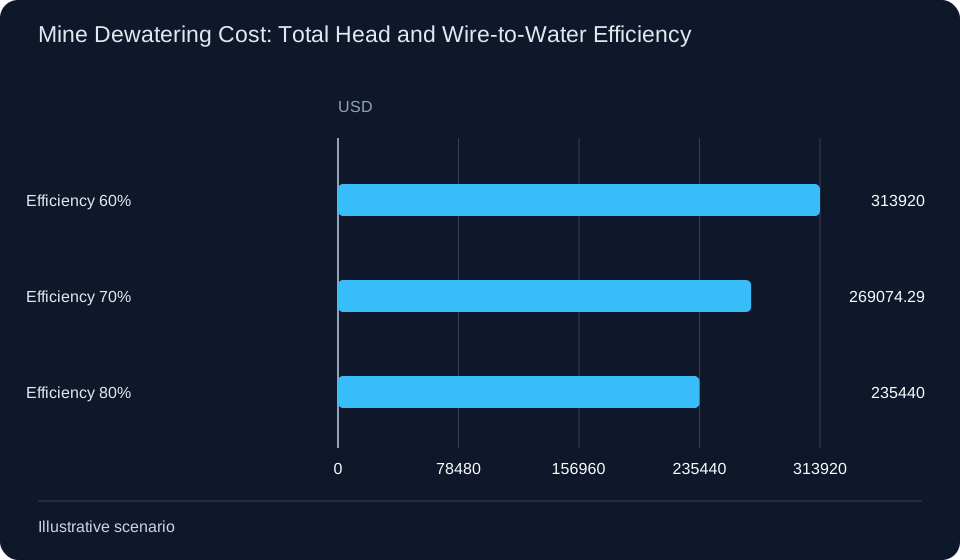
Illustrative annual pumping electricity cost at 0.10 m³/s, 200 m total head, 8000 h/year and 0.12 USD/kWh. Efficiency is total wire-to-water efficiency; all tariffs and operating inputs are hypothetical.
5. Operating and procurement decisions
Measure suction and discharge pressure, flow, water level and electrical input together. Ask the supplier for curves at the actual water chemistry, solids, speed and wear allowance, including motor and drive losses. Compare operating points near the efficient region while maintaining drainage capacity and standby coverage. A variable-speed proposal must model the static component: the familiar cubic power relationship cannot be applied to the entire duty as though static head were zero. Pipe cleaning or parallel operation may be better than a new motor if friction or poor matching dominates.
6. Limits and physical constraints
Water density is simplified; slurry, entrained gas, viscosity and abrasive solids can change both losses and pump suitability. Available net positive suction head, cavitation, corrosion, minimum flow and pressure ratings constrain the economically attractive point. Falling water levels can increase lift, so a fixed 200 m budget may understate later duty. Power interruption and flooding consequences belong in a reliability analysis, not an arbitrary surcharge on every kWh. Avoid applying pump hydraulic efficiency and total wire-to-water efficiency twice.
7. Frequently asked questions
Does a premium motor alone achieve 80%? Not necessarily; pump, drive and operating point all contribute. Can speed reduction always save cubically? No, especially with significant static lift and a fixed drainage requirement. Is 5.95 years a purchase recommendation? No; include maintenance, reliability, changing duty, financing and actual installed price before selection.
8. Sources and related analysis
Read pipeline pumping scenarios, mine reliability and transformer sizing.
- Industrial Electricity Bills: Energy, Network and Demand Costs in 2026
- EU–US Industrial Power Prices: Match Tax, Currency and Delivery Basis
- Natural Gas and LNG: From Hub Benchmark to Delivered Industrial Cost
- Brent, WTI and Refinery Energy Costs: A Margin Scenario Bridge
- Transformer Procurement: A Copper, Aluminium, Oil and Currency Cost Bridge
- Copper and Aluminium Winding Costs: Metal Pass-Through and Indexation in 2026
- GOES Electrical Steel Economics: Yield, Loss and Grade Premium in 2026
- Mineral Oil versus Natural Ester: Transformer Life-Cycle Cost Boundaries in 2026
- Lithium, Nickel and Graphite Exposure: Battery Procurement Cost Bridges in 2026
- Recycled Copper Economics: Quality, Recovery Yield and Energy Cost in 2026
- Transformer landed cost: Incoterms, ocean freight, road delivery and insurance in 2026
- Transformer heavy haul: route, permits, storage and remobilization costs
- LNG shipping economics: freight, boil-off and delivered energy cost
- Port delay economics: working capital, storage and equipment demurrage
- Diesel and bunker freight surcharges: an auditable indexation model
- Solar LCOE: Financing, Curtailment and Interconnection in 2026
- Wind Capture Price: Congestion, Export Losses and Revenue
- BESS Arbitrage: Throughput, Degradation and Net Spread
- Industrial Power PPAs: Fixed, Floating and Profile Risk
- Transformer Losses: Capital Premium, Electricity Cost and NPV
- Refinery hydrogen: separate gas, electricity and carbon costs
- LNG liquefaction: electric-drive versus gas-turbine energy cost
- Oilfield ESP economics: water cut changes the oil-cost denominator
- Gas-generator spark spread: net heat rate turns fuel into cost
- Liquid-pipeline pumping: electricity versus diesel cost scenarios
- Copper Mine Energy Cost: Grade and Recovery Matter More Than a Headline Tariff
- SAG Mill Economics: Lower kWh/t Must Preserve Throughput and Recovery
- Mine Conveyor or Haul Trucks: Energy Prices and the Throughput Break-Even
- Mine Dewatering Cost: Total Head and Wire-to-Water Efficiency
- Mine Power Reliability: Value Outage Hours, Restart Losses and Backup Costs Separately
- SFRA After Transformer Transport: Distinguishing Winding Movement from a Changed Setup
- Transformer Moisture: Why the Same ppm Means Different Risk in Mineral Oil and Ester
- Bushing Capacitance and tan δ: Build a Temperature-Consistent Trend Before Replacement
- OLTC Dynamic Resistance: Diagnose Transition-Resistor Signatures Without False Alarms
- Transformer Winding Resistance: Correct Temperature Before Comparing Phases and Factory Data
- Restricted Earth Fault: Proving the Transformer Neutral CT Zone
- GOOSE with PRP or HSR: Supervise the Trip, Not Just the Link
- 1 A or 5 A CT Secondaries: Calculate the Long-Cable Burden
- MV Breaker Failure 50BF: Build the Timer and Intertrip Budget
- NGR Continuity Monitoring: Respond to an Open or Bypassed Resistor
- BESS Transformer RFQs: Evaluate Losses Against the Actual Duty Cycle
- MV Collector Protection When Inverter Fault Current Barely Exceeds Load
- Grid-Forming BESS Black Start: Prove Transformer Energization Before Load Pickup
- Dual-LV Solar Transformers: Specify Every Pairwise Impedance and Its Base
- Renewable Collector Harmonic Scans: Include Cable Capacitance and Converter Impedance
- Refinery Voltage-Sag Ride-Through: Coordinating VFDs, Contactors and Process Permissives
- LNG Compressor Starting: A Transformer Study for Voltage Dip and Acceleration
- ESP Drives, Step-Up Transformers and Long Cables: Separating Resonance from Voltage Drop
- Pressurized Electrical Rooms in Hazardous Areas: Purge, Pressure-Loss and Trip Interfaces
- Refinery UPS Selectivity: Static Bypass, Inverter Limits and Branch Fault Clearing
- Underground Trailing Cables: Coordinate Ground Check and Neutral Protection
- Downhill Conveyor Regeneration: Specify the Transformer and Grid Interface
- Mine Hoist Transformers: Use RMS Cycle Screening Without Hiding Hot Spots
- SAG Mill Drive Transformers: Coordinate Harmonics, Filters and Network Impedance
- High-Altitude Mining Transformers: Separate Clearance and Cooling Guarantees
- Short-Circuit Test Reports: Proving Similarity to the Offered Transformer
- Transformer Noise Guarantees: Sound Power, Sound Pressure and Acceptance
- Ester Retrofill Review: Gaskets, OLTC Approval and the Remaining Mineral Oil
- Reusing a 50/60 Hz Transformer: V/Hz Is Only the First Check
- EU F-Gas Switchgear Procurement in 2026: Rated Voltage and Evidence Scope
- Ecodesign Tier 2 Transformer Standards: No-Load and Load-Loss Limits
- No-Load Loss (P0) Reduction Physics: Laser-Scribed CRGO vs Amorphous Alloy Cores
- Transformer Load Loss (Pk) Optimization: CTC Conductors and Stray Loss Mitigation
- Cast Resin Dry-Type vs Liquid-Immersed Transformers: Selection Guide
- Forced Air (AF) Cooling Dynamics in Cast Resin Transformers: +40% Power Uprating
- Partial Discharge (PD) Testing and Diagnostics in Cast Resin Transformers
- Ester Dielectric Fluids in Power Transformers: Natural vs Synthetic Esters vs Mineral Oil
- Transformer Thermal Modeling and Winding Hot-Spot Calculation (IEC 60076-2 / IEC 60076-7)
- Conservator Preservation Systems, Buchholz Relays, and DGA Duval Triangle Diagnostics
- Step-Up Transformer Engineering for Utility Solar PV, Wind and BESS Plants
- Wind Turbine Nacelle and Tower Transformers: 3G Vibration and Marine Corrosion Design
- BESS Battery Energy Storage Coupling Transformers: Four-Quadrant P-Q Operation and dV/dt Stresses
- Substation Step-Down Power Transformers (110 kV to 330 kV): Design & OLTC Regulation
- On-Load Tap Changer (OLTC) Vacuum Technology and Automatic Voltage Regulation (AVR)
- Ultra-High Voltage (UHV 1000 kV) Transformers and SCB18 Dry-Type Technology
- Generator Step-Up (GSU) Transformers: Saturation, Overfluxing (V/Hz), and Tertiary Stabilizing Windings
- Heavy Industry Process Transformers: Electric Arc Furnace (EAF) & Green Hydrogen Rectifiers
- Variable Frequency Drive (VFD) Multi-Pulse Isolation Transformers: Harmonic Cancellation
- Grounding Transformers (Zigzag ZN) and Neutral Earthing Resistors (NGR): Sizing & Fault Duty
- Medium Voltage Switchgear Selection: Air-Insulated (AIS) vs Gas-Insulated (GIS)
- Vacuum Circuit Breaker (VCB) Switching Dynamics: Transient Recovery Voltage (TRV) and RC Snubbers
- Ring Main Units (RMU) for Secondary Distribution: Architecture, CCF Topologies, and Telemetry Automation
- Transformer Differential Protection (ANSI 87T): Biased Slope, Inrush Restraint, and CT Saturation
- IEC 61850 Substation Automation: GOOSE Messaging, Sampled Values (SV), and Process Bus Protection
- Prefabricated and Pad-Mounted Substations: IEC 62271-202 Selection Guide
- Diesel and Gas Generator Sets: ISO 8528 Rating and Selection Guide
- Instrument Transformers: CT and VT Selection for Metering and Protection
- Surge Arresters and Insulation Coordination: IEC 60099-4 / IEC 60071 Guide
- Power Quality and Reactive Compensation: Capacitor Banks, SVC and STATCOM
- Medium-Voltage Cables and Busways: Ampacity, Voltage Drop and Short-Circuit Selection
- Industrial Motor Selection: IEC 60034 Ratings, Starting and IE Efficiency
- UPS, BESS and Critical Power: Autonomy, Topology and Safety Selection
- Transformer FAT and Site Commissioning: IEC 60076 Test Plan
- Mobile Emergency Substations: Rapid Deployment and Interface Selection
- Rail Traction Transformers: AC/DC Supply, Regeneration and Vibration Duty
- Shore Power Transformers: IEC/IEEE 80005-1 HVSC Interface Design
- Mining and Flameproof Transformers: Ex-Zone, Cooling and Protection Selection
- LV Power Switchboards: IEC 61439 Design Verification and Assembly Data
- LV Breakers, Switches, Fuses and Contactors: IEC 60947 Coordination
- Automatic Reclosers and Feeder Automation: IEC 62271-111 Selection
- MV Feeder Protection Settings: 50/51, 67, 79 and IEC 60255 Evidence
- Generator ATS, AMF and Paralleling: ISO 8528 and IEC 60947-6-1
- Power Meters and Power-Quality Monitoring: IEC 61557-12 / 61000-4-30
- PV Inverter Grid Connection: Anti-Islanding, Reactive Power and Transformer Interface
- EV Charging Infrastructure: Transformer Sizing, Protection and IEC 61851
- Pad-Mounted Transformers: Dead-Front Loop-Feed Design, Fusing and IEEE C57.12.26
- Monoblock Concrete Substations: Internal Arc (IAC-AB), Ventilation and IEC 62271-202
- Biogas and Landfill CHP Gensets: Fuel Gas Treatment, Methane Number and ISO 8528
- Synchronous Generator Protection and Grid Code Compliance: ANSI 32, 40, 46, 81 and FRT
- Electrostatic Shielded Solar Transformers: Inverter Harmonics, K-Factor and Ester Oil
- Busbar Differential Protection (ANSI 87B): High-Impedance vs Distributed Numerical Architecture
- Transmission Autotransformers: Delta Tertiary Stabilization, Zero-Sequence Impedance and Sizing
- Amorphous Metal Core Transformers: Fe-Si-B Ribbon Physics, Acoustic Design and Life-Cycle TOC
- Subsurface and Vault-Mounted Distribution Transformers: Flood Protection and IEEE C57.12.40
- Emergency Diesel Generator Fast-Starting: ISO 8528-5 Class G3 Dynamics and NFPA 110
- Submerged Arc Furnace (SAF) Transformers: High-Current Secondary Bus Electrodynamics
- Floating Solar PV (FPV) Transformer Substations: Marine Corrosion, Buoyancy and Tilt
- ETAP Alternative for Single Line Diagrams: A Practical Selection Guide
- How to Create an Electrical Single Line Diagram Online
- Single Line Diagram vs Load-Flow Model: Validation Before Analysis